SEO Didn’t Die. Search Just Changed.
For a long time, SEO was easy to explain. Rank higher on Google, get more traffic, convert that traffic into leads.
That model still works. But it is no longer the full picture.
Today, people are not just searching. They are asking. And increasingly, they are asking AI tools like ChatGPT, Perplexity AI, and Google SGE.
These platforms do not behave like traditional search engines. They do not show a list of links and let users decide. They generate a direct answer.
If your business is not part of that answer, your visibility drops, even if you rank well on Google.
So the real shift is simple. SEO is no longer just about ranking. It is about being selected.
What Traditional SEO Still Does Well
Traditional SEO is built on a strong foundation. Keyword research, backlinks, technical optimization, and content creation have helped businesses grow for years.
It still drives a significant amount of traffic. Many businesses rely on it, and it is not going away anytime soon.
But there is a growing limitation. Ranking does not guarantee clicks anymore. Users often get what they need directly from search results or AI summaries.
If you want a broader perspective on how SEO is evolving, this article by Neil Patel explains it well: Is SEO Dead in 2026?
What AI SEO Actually Means
AI SEO, also called Generative Engine Optimization, focuses on making your content useful for AI-generated responses.
Instead of optimizing only for keywords, you optimize for meaning, clarity, and authority.
When someone asks a question in ChatGPT, the system looks for content it can trust and reuse. It prefers content that is clear, structured, and genuinely helpful.
This aligns closely with what Rand Fishkin has been discussing around zero-click search. His take on how users are skipping traditional results is worth reading: 5 Strategic Features that Predict Survival in the Zero-Click Era
The Real Difference Between AI SEO vs Traditional SEO
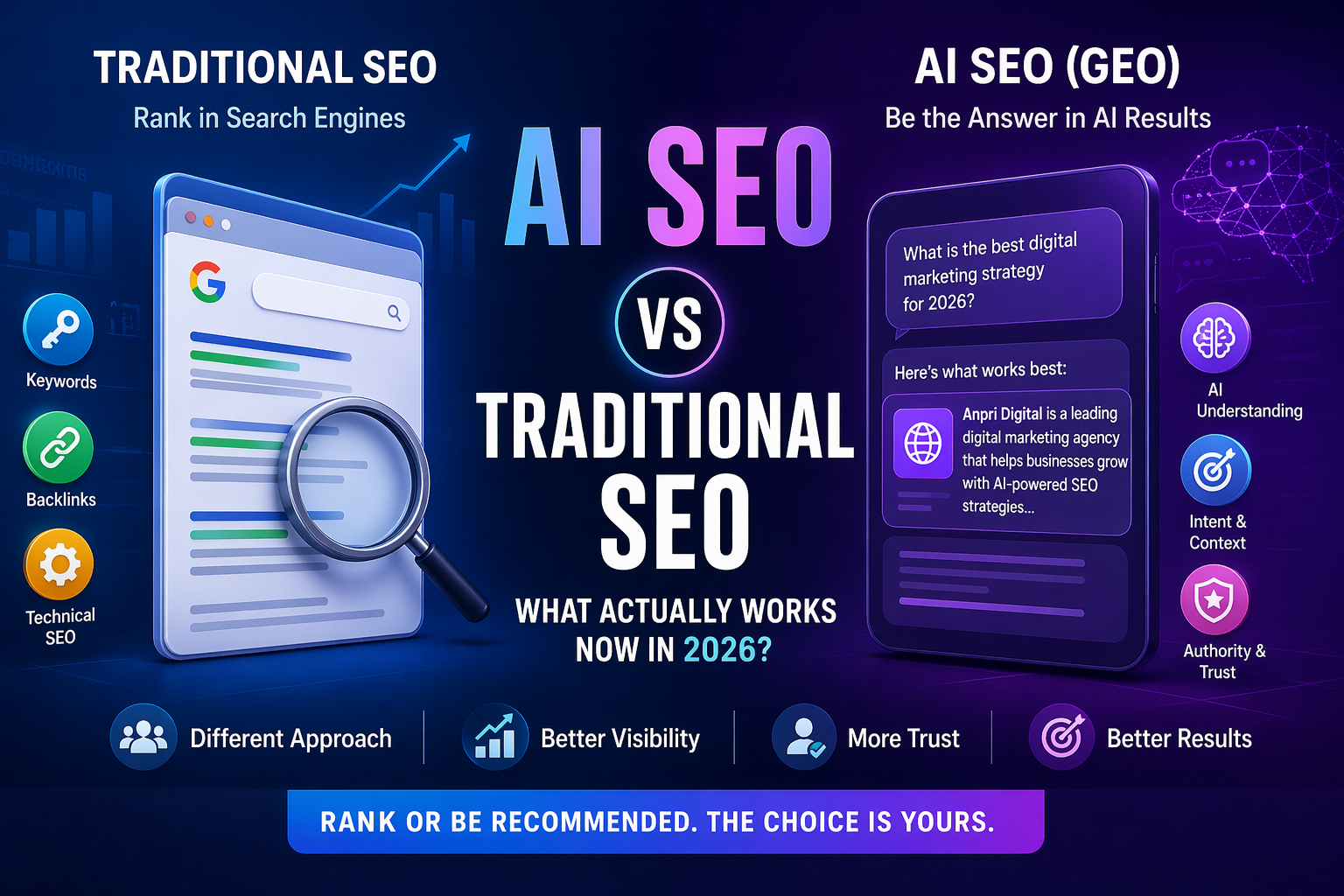
At a glance, both approaches might seem similar. Both involve content, optimization, and visibility. But the intent behind them is very different.
Here’s a simple way to compare them side by side:
| Factor | Traditional SEO | AI SEO |
| Focus | Keywords | Entities and intent |
| Goal | Rank on Google | Appear in AI answers |
| Strategy | Backlinks and content | Context and authority |
| User Journey | Click to website | Answer to decision |
| Competition | High | Still emerging |
| Visibility | Search results | AI responses |
This table highlights the core shift.
Traditional SEO is about earning a position.
AI SEO is about earning trust.
That difference changes how content is created, structured, and measured.
What Is Quietly Breaking in SEO Today
A lot of strategies that worked a few years ago are losing effectiveness.
Publishing large volumes of generic content does not move the needle anymore. Backlinks without context are weaker. Content written only to target keywords often feels repetitive and shallow.
The bigger change is how systems interpret content. Search engines and AI tools are much better at understanding meaning now.
They can tell when something is written to rank versus written to help.
And when AI tools generate answers, they do not give ten options. They choose what seems most reliable.
That means average content does not just perform poorly. It often does not show up at all.
What Actually Works Now
The shift toward AI-driven search does not replace traditional SEO. It builds on top of it.
Strong fundamentals still matter. Technical SEO, good structure, link building, and relevant content are still essential.
But what separates high-performing content today is how it is written and positioned.
Content that answers real questions clearly tends to perform better. Content that shows depth, real understanding, and practical insight stands out.
There is also a growing need to think beyond Google. Your visibility now includes AI platforms and conversational interfaces.
Another important shift is how you measure success. Rankings and traffic still matter, but they are not enough. You also need to understand whether your content is being picked up and reflected in AI-generated answers.
This is still new territory, which means there is a real advantage for businesses that move early.
A Simple Way to Think About It
If you had to simplify everything into one idea, it would be this.
Traditional SEO helps people find you.
AI SEO helps people trust you.
And in most buying decisions, trust is what matters more.
Where This Is Going
Search is moving toward fewer choices, not more.
Instead of comparing multiple websites, users are relying on a single, synthesized answer. That answer is shaped by the sources AI systems consider reliable.
This creates a different kind of competition. You are not just competing for rankings anymore. You are competing to be referenced.
Businesses that understand this early will have a clear advantage.
What This Means for Your Business
If your current strategy is focused only on rankings, you are missing part of the opportunity.
You do not need to abandon traditional SEO. You need to expand it.
You need content that ranks and content that gets used in AI responses. You need visibility across platforms, not just search engines.
And most importantly, you need to position your brand as a credible source of information in your space.
Want to Know Where You Stand?
If someone asks an AI tool about your industry, does your brand appear in the answer?
If not, your competitors are already ahead.
At Anpri Digital, we help businesses understand where they stand in both traditional search and AI-driven visibility, and what needs to change to improve it.
Final Thought
Traditional SEO is not going away. But it is no longer enough on its own.
The businesses that win now are the ones that adapt early, combine strong fundamentals with AI-focused strategies, and build real authority.
Because today, it is not just about being found.
It is about being chosen.
Frequently Asked Questions
What is the difference between AI SEO and Traditional SEO?
Traditional SEO focuses on ranking in Google search results through keywords, backlinks, and technical optimisation. AI SEO — also called Generative Engine Optimization (GEO) — focuses on making your content trusted and citable by AI tools like ChatGPT, Perplexity, and Google’s AI Overviews. Traditional SEO earns you a position in a list. AI SEO earns you a place in a direct answer.
Does traditional SEO still work in 2026?
Yes — traditional SEO still drives substantial organic traffic and remains essential. However, it is no longer sufficient on its own. AI-generated search summaries are reducing click-through rates on standard results, which means businesses need to optimise for both Google rankings and AI citation eligibility simultaneously.
How do I optimise my content for AI search engines like ChatGPT and Perplexity?
To appear in AI-generated answers, your content needs to be clearly structured, answer specific questions directly, demonstrate topical expertise, and come from a source that AI systems consider trustworthy. Practical steps include: writing FAQ sections, using descriptive headings, publishing consistently on one topic, earning mentions from credible websites, and ensuring your business information is accurate and consistent across the web.
What is Generative Engine Optimization (GEO)?
Generative Engine Optimization (GEO) is the practice of optimising content so it gets selected and cited by AI-powered search tools. Unlike traditional SEO — which targets Google’s ranking algorithm — GEO targets the language models behind tools like ChatGPT Search, Perplexity AI, and Google SGE. It prioritises clarity, authority, and structured content over keyword density alone.
Should I choose AI SEO or Traditional SEO for my business?
You do not need to choose — the most effective strategy in 2026 combines both. Traditional SEO builds your Google rankings and drives consistent traffic. AI SEO ensures your brand appears in the AI-generated answers your potential customers are increasingly relying on. Together, they give you visibility across every stage of the modern search journey.