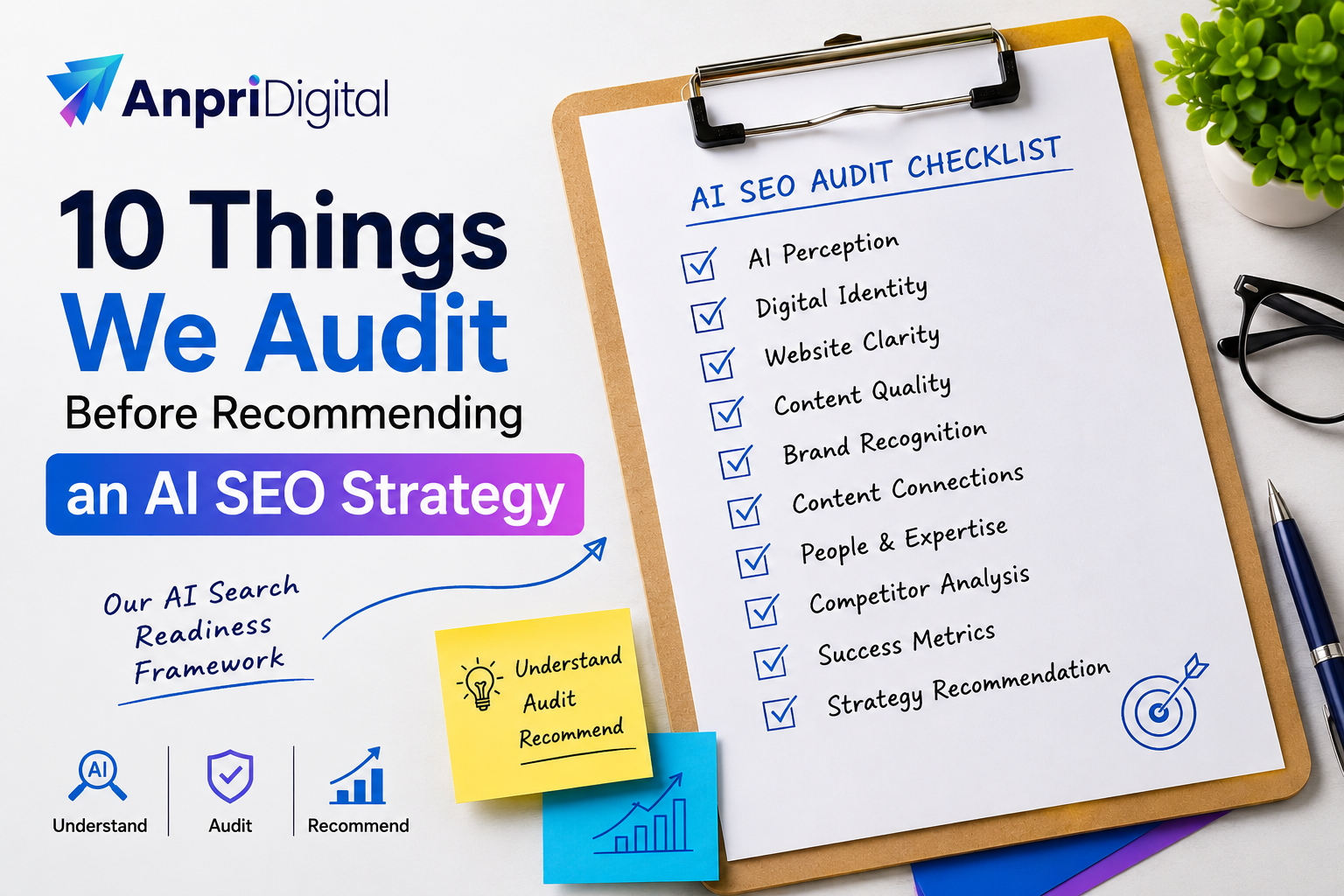
Inside the AI Search Readiness Framework we use before recommending AI SEO to a client.
Introduction
Over the past few months, we’ve been hearing the same question from almost every new enquiry:
“Can you help us show up in ChatGPT?”
Sometimes it’s about Google AI Overviews. Sometimes it’s Gemini or Perplexity. And sometimes it’s simply:
“We’re hearing a lot about AI SEO. Is it something we should be doing?”
Our answer is usually the same.
Maybe. But before we talk about AI SEO, we first need to understand whether your business is actually ready for AI search.
Many businesses expect recommendations for more content, more schema, or more backlinks. Instead, we start by understanding how AI currently sees the business.
We’ve worked with businesses that rank well on Google but receive little visibility in AI-generated answers. We’ve also seen smaller brands appear surprisingly often because AI had a clearer understanding of their expertise, services, and reputation.
That experience changed how we approach AI SEO.
Traditional SEO still matters. Technical health, helpful content, backlinks, and user experience remain important foundations. But AI SEO is adding another layer of visibility.
Potential customers can now ask ChatGPT for recommendations, compare providers through Google AI Overviews, or research a company through Gemini or Perplexity before visiting its website.
So we’re no longer asking only:
- How well does this website rank?
- How much organic traffic does it receive?
We’re also asking:
- Does AI recognise this business?
- Does it understand its expertise?
- Would it confidently recommend the brand?
Those questions led us to develop the AI Search Readiness Framework we use before recommending an AI SEO strategy.
Our AI Search Readiness Framework
Our framework has five stages: Understand, Validate, Evaluate, Strengthen, and Recommend.
Each stage answers a different question about your business, from how AI currently perceives you to what you should prioritise next.
The important part is the order. We audit first and recommend later.
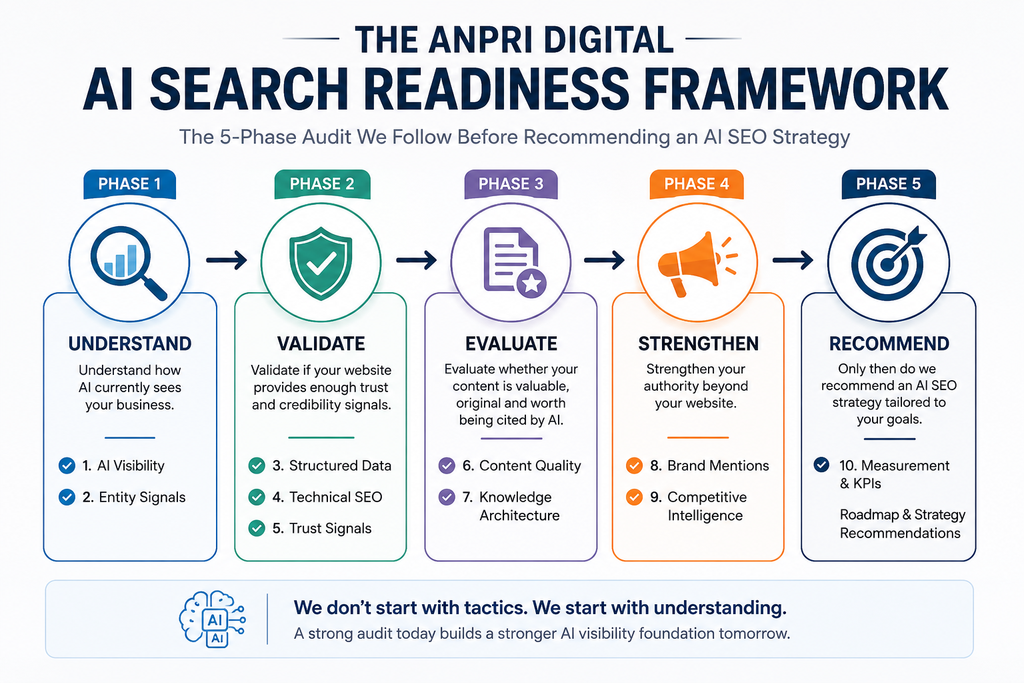
Our framework has five stages:
1. Understand – How does AI currently perceive your business?
2. Validate – Are you sending clear and consistent signals?
3. Evaluate – Is your content genuinely useful and worth referencing?
4. Strengthen – How does your digital presence compare with competitors?
5. Recommend – What should you prioritise based on the findings?
The important part is the order. We audit first and recommend later.
1. We Start by Understanding How AI Already Sees Your Business
Before reviewing your website, we ask:
What does AI already know about your business?
We ask AI platforms questions a potential customer might ask:
- Who is this business?
- What does it do?
- Who are its competitors?
- Would you recommend it?
We’re not looking for perfect answers. We’re looking for gaps.
Can AI accurately identify the business? Does it recognise its services and expertise? Would it confidently recommend the brand?
This gives us a baseline before any optimisation begins.
Anpri Digital Insight: AI visibility isn’t always a ranking problem. Sometimes it’s a recognition problem.
2. We Validate Your Digital Identity
AI doesn’t just analyse individual web pages. It connects information from multiple sources.
That’s why we review whether your business presents consistent information across:
- About page
- Organization schema
- Google Business Profile
- Founder and author profiles
- Social platforms
- Business listings
Imagine five websites describing your business in five different ways. Which version would you trust?
AI faces a similar challenge.
The clearer and more consistent your digital identity, the easier it becomes to recognise your business. This is where entity SEO becomes particularly important.
Key Takeaway: Before creating more content, make sure your business tells the same story everywhere.
3. We Check Whether AI Can Clearly Interpret Your Website
A website can look excellent to visitors and still be difficult for AI to interpret.
We review structured data, service information, author details, business information, and how consistently those signals appear across the website.
The goal isn’t to add more schema.
It’s to remove ambiguity.
Schema can help AI interpret information, but it isn’t an AI SEO strategy by itself. Our approach to entity SEO and structured data focuses on making those signals consistent with the rest of the website. It works best when it accurately reinforces what the rest of the website is already communicating.
Anpri Digital Insight: We’ve seen websites with technically valid schema but weak entity signals. Structured data works best when it supports a consistent digital presence.
4. We Ask: Is Your Content Worth Citing?
Publishing more content doesn’t automatically improve AI visibility.
We look for content that demonstrates experience, answers real questions, provides practical insights, and contributes something useful rather than repeating information already available elsewhere.
The question we often ask is:
If another marketer, journalist, or AI system discovered this page, would they consider it worth referencing?
The most valuable content isn’t necessarily the longest.
It’s the content that provides a useful perspective or genuinely solves a problem.
Key Takeaway: Don’t create content just to rank. Create content that’s worth citing.
5. We Measure Brand Recognition, Not Just Backlinks
Backlinks remain valuable, but they aren’t the only signals that contribute to digital authority.
AI can encounter your brand through:
- Industry publications
- Reviews
- Interviews
- Podcasts
- Business profiles
- Brand mentions
- Other trusted websites
We review how consistently your business is mentioned across the web and whether those brand mentions reinforce the expertise you want to be known for.
Anpri Digital Insight: Authority isn’t built only through links. It’s built through recognition and reputation.
6. We Review How Your Content Connects Together
One of the biggest mindset shifts we’ve made is this:
Search engines rank pages. AI connects topics.
That’s why internal linking is about more than navigation.
We review topic clusters, service pages, internal links, and supporting articles to see whether they work together to demonstrate your expertise.
A well-connected content structure gives both users and search systems a clearer picture of what your business knows.
Key Takeaway: Don’t build isolated pages. Build connected knowledge.
7. We Audit the People Behind the Brand
Businesses build brands.
People build credibility.
We review founder information, author profiles, About pages, and other signals that demonstrate who’s behind the content.
This is particularly important for consultants, agencies, professional services firms, SaaS companies, and other expertise-led businesses.
Your experience shouldn’t remain invisible.
Anpri Digital Insight: Businesses often invest heavily in content while overlooking the people creating it. Visible expertise can be one of your strongest trust signals.
8. We Compare You Against Businesses Already Winning
AI visibility is relative.
Your competitors can provide valuable clues about what is working in your industry.
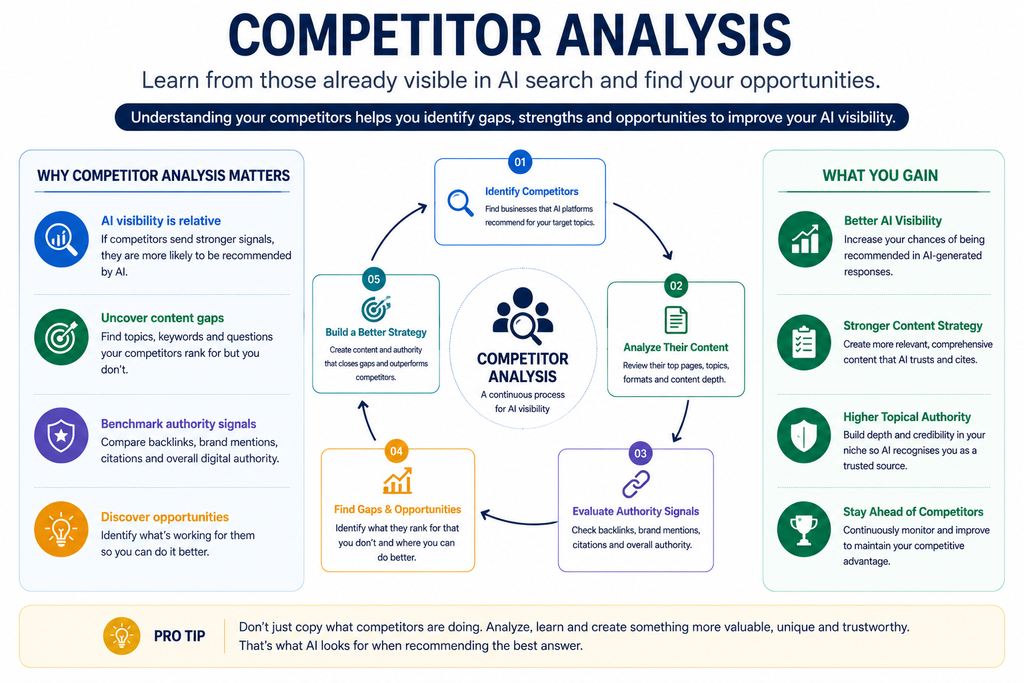
We compare factors such as:
- Topical coverage
- Content depth
- Entity signals
- Brand recognition
- Digital authority
- AI visibility
The goal isn’t to copy competitors.
It’s to understand where they are stronger, where gaps exist, and where your business has an opportunity to differentiate.
Key Takeaway: Benchmark before you optimise.
9. We Agree on What Success Looks Like
One of the first questions clients ask is:
“How will we measure AI SEO?”
It’s a fair question.
There isn’t one universal metric.
Depending on the business, we may track AI citations, brand mentions, AI visibility trends, qualified traffic, referrals, or leads.
The important thing is to define meaningful outcomes before the work begins.
Anpri Digital Insight: If success isn’t clearly defined at the beginning, it’s difficult to measure progress later.
10. Only Then Do We Recommend an AI SEO Strategy
This is where many businesses expect us to begin.
For us, it’s the final step.
By this point, we’ve identified the biggest gaps, validated the foundations, reviewed the competitive landscape, and prioritised the opportunities that are most relevant to the business.
Sometimes the recommendation is a complete AI SEO strategy.
Other times, the right first step is improving entity signals, strengthening content, or building authority.
There is no universal checklist.
The best AI SEO strategy is the one that solves the right problems in the right order.
What We’ve Learned
After auditing businesses across different industries, we’ve noticed several patterns appear again and again.
Businesses often:
- Treat AI SEO as simply a content strategy.
- Focus on rankings instead of recognition.
- Overlook their About page and digital identity.
- Publish content without adding original insights.
- Expect quick results.
- Ignore their presence beyond their own website.
- Apply the same strategy regardless of industry or business maturity.
The businesses making the biggest gains aren’t necessarily publishing the most content.
They’re building stronger foundations.
AI SEO isn’t about doing more.
It’s about doing the right things in the right order.
The Tools We Use
We’re often asked:
“What tools do you use for AI SEO?”
The honest answer is that there isn’t one platform that can perform a complete AI SEO audit.
We use a combination of tools to review technical SEO, entity signals, AI visibility, brand mentions, content, and competitors.
The tools support the audit.
They don’t replace strategy.
Anpri Digital Insight: The right strategy will always matter more than having the biggest software stack.
Tools don’t improve AI visibility. They help you understand where to focus.
Who Should Use This Framework?
You don’t need to be an SEO expert to benefit from an AI Search Readiness Audit.
This framework can be useful for:
- Business owners preparing for AI-powered search.
- Marketing managers developing an AI SEO roadmap.
- SEO professionals expanding beyond traditional search.
- Digital agencies introducing AI SEO services.
- SaaS and B2B companies strengthening their digital authority.
Whether you’re just getting started or already investing in AI SEO, understanding where you stand today is the best place to begin.
One Final Thought Before You Start AI SEO
When we first started exploring AI search, we expected the biggest changes to be technical.
We were wrong.
The biggest shift wasn’t about new tools or algorithms.
It was about understanding how AI evaluates businesses.
The brands that consistently appear in AI-generated answers usually have something in common.
They’re easy to recognise.
They’re trusted.
And they make their expertise clear.
That’s why every AI SEO strategy we recommend begins with an audit, not an action plan.
If there’s one idea we’d like you to take away from this guide, it’s this:
Don’t ask, “How do we rank in AI?”
Ask, “How well does AI recognise our business today?”
The answer to that question will shape every decision that follows.
Frequently Asked Questions
What is an AI Search Readiness Audit?
An AI Search Readiness Audit evaluates how AI platforms perceive your business and identifies opportunities to improve visibility across AI-powered search experiences.
How is AI SEO different from traditional SEO?
Traditional SEO focuses primarily on improving search rankings. AI SEO focuses on helping AI platforms recognise, trust, and confidently reference your business.
Can AI SEO improve visibility in ChatGPT?
No strategy can guarantee visibility in ChatGPT or any AI platform. AI SEO can, however, strengthen the signals that help AI recognise and reference your business.
Is schema markup enough for AI SEO?
No. Schema is an important foundation, but AI SEO also involves content quality, entity signals, authority, brand recognition, and other digital trust signals.
Do I need paid AI SEO tools?
Not necessarily. An initial AI Search Readiness Audit can often be completed using a combination of free and affordable tools.
Does AI SEO replace traditional SEO?
No. AI SEO complements traditional SEO. Technical SEO, helpful content, authority, and a strong website remain important foundations.
Curious How AI Currently Sees Your Business?
Before investing in AI SEO, it’s worth understanding where your business stands today.
Our AI Search Readiness Audit helps identify visibility gaps, evaluate your digital foundations, and prioritise practical improvements based on your business goals.
If you’d like to understand how AI currently perceives your business, we’d be happy to help.
Explore our AI SEO Services or book an AI Search Readiness Audit to discover where your biggest opportunities lie.
Disclaimer
AI search is evolving rapidly, and the capabilities of platforms such as ChatGPT, Google AI Overviews, Gemini, Claude, and Perplexity continue to change.
The guidance in this article is based on our experience, publicly available documentation, and industry practices available at the time of writing. No AI SEO strategy can guarantee inclusion or visibility in AI-generated answers.
This guide is intended for educational purposes and reflects the approach we follow at Anpri Digital. Every business is different, so recommendations should be tailored to the business, industry, objectives, and level of digital maturity.