You could rank on page one of Google today and still be completely invisible to ChatGPT, Perplexity, or Google AI Overviews. Not because your content is poor. Because AI systems have no idea who you are. That is the problem entity SEO solves.
Most businesses are still building SEO strategies around keywords. Google moved on from that years ago. AI search platforms have taken it even further. When someone asks ChatGPT to recommend an AI SEO agency, the system does not pull the top-ranked page. It looks for organisations it already recognises as credible sources in that space. If your brand does not exist in its understanding of the world, you do not come up.
This post covers what entity SEO is, why it matters right now, and what you can do practically to build entity authority for your business.
So what exactly is an entity SEO?
Google defines an entity as “a thing or concept that is singular, unique, well-defined and distinguishable.” People, businesses, places, products, services, topics — all of these qualify.
The key difference from a keyword is that an entity is a recognised real-world thing, not a string of text. When you type “best coffee in Hyderabad,” Google is not just matching those six words to pages that contain them. It is cross-referencing location entities, business entities, and category entities to build an answer from a knowledge network it has spent years constructing.
That network is called the Knowledge Graph. It contains billions of entities and the relationships between them. Your brand either exists in it as a recognisable node with verified attributes, or it does not. There is no middle ground.
Since 2025, Google’s Gemini AI has been trained directly on the Knowledge Graph. This is why entity SEO has shifted from a niche technical tactic to something that affects every business trying to be visible in search.
Why Entity SEO matters specifically right now
Search Engine Land published a piece in March 2026 that framed it well: the webpage is no longer the unit of digital visibility. The entity is. Pages are containers. Entities are what AI systems remember, compare, cite, and shortlist.
Two things have happened at the same time to make this urgent.
First, AI-generated answers are eating into organic clicks. Data from April 2026 shows that Google AI Overviews reduce click-through rates on the top organic result by an average of 34.5%. Ranking well and getting traffic are no longer the same thing. Businesses that appear inside AI-generated answers, cited as sources, are in a fundamentally different position to those that appear below them.
Second, research on arXiv in 2026 found that AI Overview citations frequently do not come from the highest-ranking pages. They come from sources that AI systems trust. Entity clarity, how clearly and consistently a brand is described and corroborated across the web, turns out to be a better predictor of AI citation than ranking position alone.
Both of these trends point in the same direction. The question is no longer just “how do we rank?” It is “does Google know who we are well enough to recommend us?”
Read more on this in our post on Google AI Overviews Are Changing SEO — And Most Businesses Aren’t Ready.
The five entity types your business should focus on
Not every entity type carries equal weight for most businesses. These five are worth prioritising:
| Entity Type | What It Covers |
| Organisation entity | Your brand as a recognisable, verifiable company |
| Person entity | Founders, team members, named content authors |
| Topic/concept entities | AI SEO, GEO, structured data, entity SEO |
| Service entities | Specific services linked to your brand |
| Location entity | City, region, business address |
One thing worth knowing: Knowledge Panels for corporate entities became much more widely available in early 2025. They had previously been reserved almost entirely for well-known individuals. Now smaller organisations can get them too, provided the entity signals are clear enough. Founders and named team members matter here as well, because their person entities reinforce the organisation entity they belong to.
Your About page is doing more work than you think
There is a concept that has gained significant traction in 2026 called the Entity Home. Jason Barnard, writing in Search Engine Land in March 2026, described it as the single URL that anchors how algorithms, AI bots, and human visitors understand your brand.
In almost every case, that page is your About page.
Most businesses treat the About page as a background story. A bit of history, a mission statement, some team photos. But for Google’s systems and AI crawlers, it is something more specific. It is the place where they try to resolve your identity. It needs to answer, without any ambiguity: who is this organisation, what does it do, when did it start, where does it operate, and who leads it.
And those answers need to match what other sources around the web say about you. If your About page says one thing, your LinkedIn says something slightly different, and your Google Business Profile says something else again, AI systems treat that as noise rather than signal. That inconsistency has a name in entity SEO circles: algorithmic brand debt. It compounds over time and becomes progressively harder to correct.
A quick practical test: paste your About page text into the free Google Natural Language API demo. It will show you which entities Google extracts from your content, how prominently, and how it categorises them. Most businesses are surprised by how little of their brand identity is actually being picked up.
How to build entity authority in practice
Get your Organisation schema right
Schema markup in JSON-LD format is the most direct way to declare your entity to search engines and AI systems. The Organisation schema on your homepage and About page should include your name, URL, logo, founding date, and a clear description.
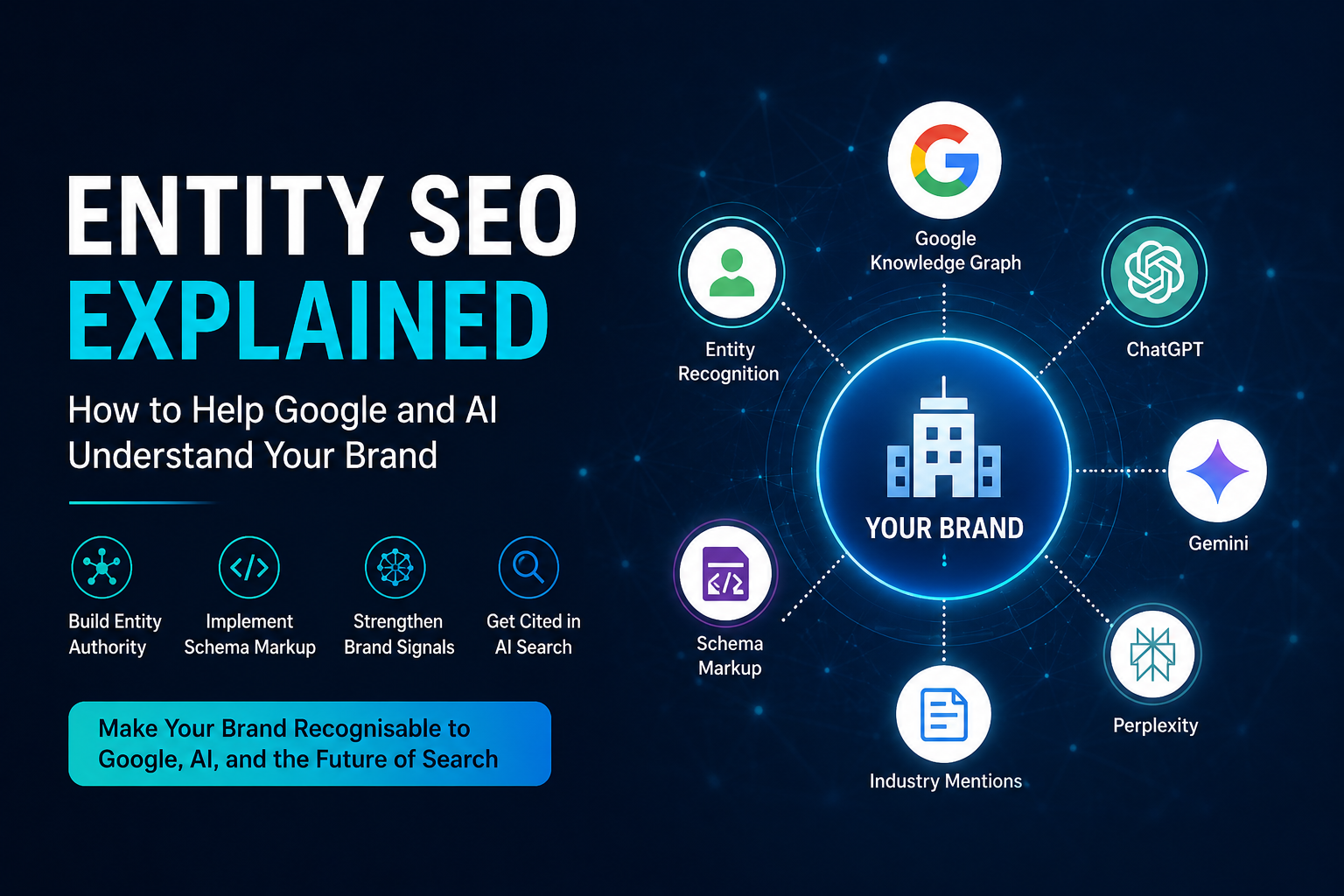
The property that matters most is sameAs. This is an array of URLs pointing to every authoritative external profile associated with your brand: LinkedIn, Instagram, X, Crunchbase, and ideally a Wikidata entry. The sameAs property tells AI systems that your website entity is the same entity as all of these other profiles. Without it, they have to infer those connections, which they often get wrong or skip entirely.
Post-March 2026, the knowsAbout property has also become more impactful. Declaring the specific topics your organisation has expertise in creates a topical authority signal that AI Mode and AI Overviews use when selecting sources for queries in those areas.
Create a Wikidata entry
Wikidata is more accessible than Wikipedia and arguably more valuable for entity SEO. There is no strict notability threshold. What it provides is a structured, machine-readable record of your entity that feeds directly into Google’s Knowledge Graph. A Wikidata entry listing your organisation’s name, industry, country, founding date, official website, and social profiles gives AI systems a clean, verified reference point.
If your business has been operating for a reasonable period of time, creating a Wikidata entry is achievable and worth doing early.
Build topic cluster content around your core areas
If you want AI systems to associate your brand with AI SEO, you need more than one article about it. You need content that covers the full topic landscape: GEO, AEO, entity SEO, conversational search optimisation, structured data, topical authority. Each piece reinforces the semantic relationships between your brand and the topic cluster.
Search Engine Journal noted in April 2026 that entity authority is evaluated across three dimensions: recognition, relationships, and corroboration. Topic cluster content is what builds the relationship layer. It tells AI systems not just that your brand exists, but that it consistently operates within a specific domain of knowledge.
This is explored further in our post on AI SEO vs Traditional SEO: What Actually Works Now in 2026.
Get mentioned externally, with or without links
Every time your brand appears in an industry publication, a podcast transcript, a guest article, or even a cited source, it adds corroboration to your entity. AI platforms are trained on the wider internet. They look for patterns of co-occurrence: if your brand name consistently appears alongside AI SEO, Hyderabad, and digital marketing in credible external sources, those associations become part of how they understand you.
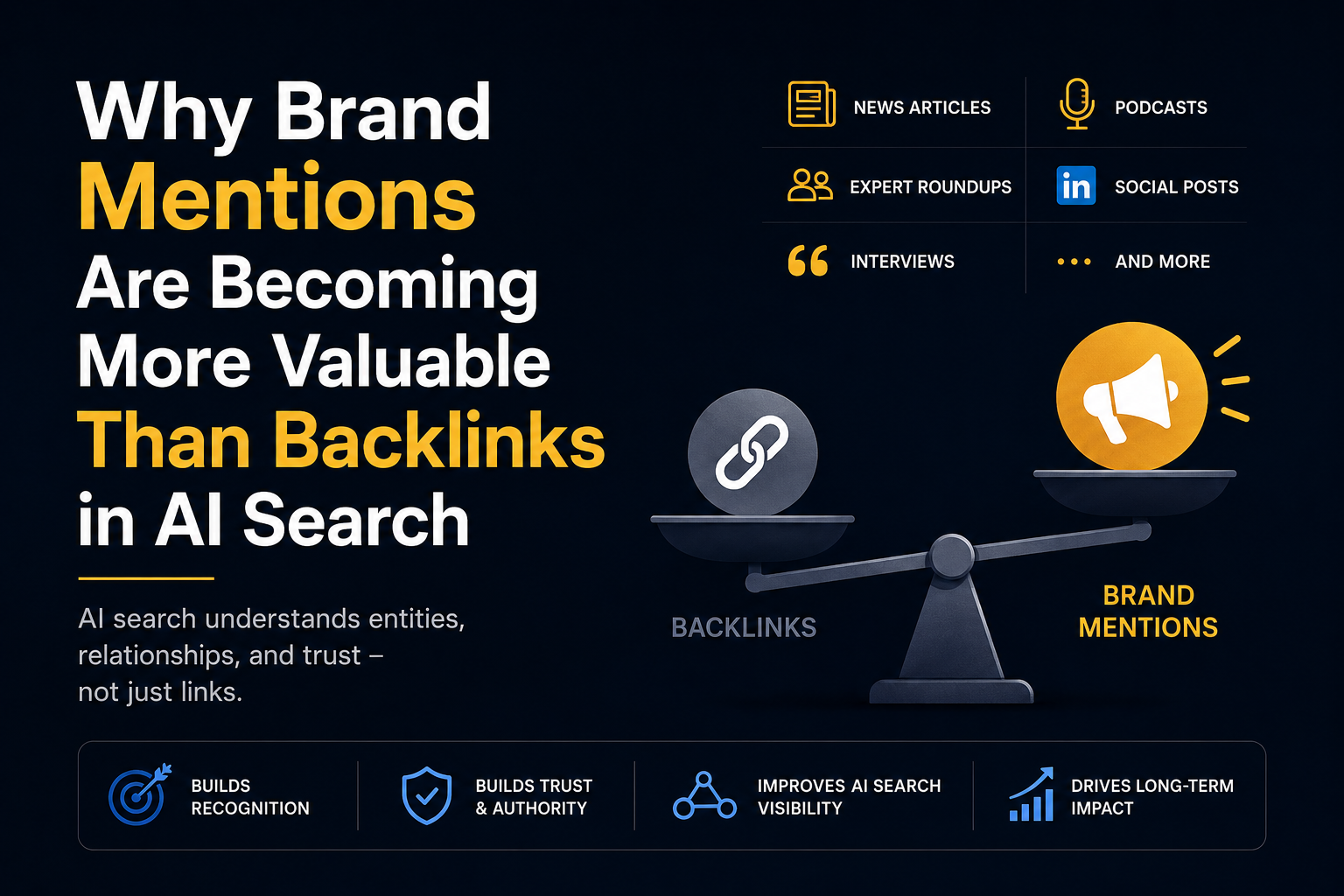
Unlinked mentions count. The relationship between brand mentions and AI visibility is something we covered in detail in Why Brand Mentions Are Becoming More Valuable Than Backlinks in AI Search.
Name your authors properly
This one is straightforward and widely ignored. Every post on your site should be attributed to a real, named person with a proper bio, a LinkedIn profile, and Person schema that includes sameAs pointing to their external profiles. An author entity connected to your brand entity reinforces the whole structure. “Admin” does nothing.
A quick check to see where you stand today
Before doing anything else, spend five minutes on these four checks:
Search your brand name on Google. Does a Knowledge Panel appear? If not, your entity is not yet established enough for Google to surface it confidently.
Run your About page text through the Google NLP API demo. Is your brand name being extracted as a high-salience entity?
Search “[your brand] + [your core topic]” on Google. Does the association exist?
Type your main service query into ChatGPT or Perplexity. Do you appear? If competitors do and you do not, that gap is fixable, but it takes time to close.
FAQ
What is entity SEO?
Entity SEO is the practice of making your brand, your people, and your core topics recognisable and trustworthy to search engines and AI systems. It involves structured data, consistent brand signals across the web, and content that builds clear topical associations.
How is it different from traditional SEO?
Traditional SEO optimises pages to match keywords. Entity SEO builds a machine-readable identity for your brand so AI systems know who you are and what you are authoritative on. Both matter, but entity SEO is what determines whether you appear in AI-generated answers at all.
What is the Google Knowledge Graph?
A database of billions of entities and the relationships between them. It powers Knowledge Panels, Google AI Overviews, and Gemini AI. Getting your brand into it as a recognised entity is one of the most valuable things you can do for long-term AI search visibility.
How long does it take?
Schema implementation and Wikidata setup can show early signals within four to eight weeks. Meaningful AI citation visibility typically takes three to six months of consistent work across content, mentions, and structured data.
Entity SEO is not a quick fix. Building recognition takes consistent effort across your website, your external presence, and your content. But it compounds. And with most businesses still focused purely on rankings, there is a real early-mover advantage for those who get it right.
Our AI SEO and GEO services include a full entity audit for every client. If you want to know where your brand stands, get a free AI SEO audit and we will walk you through it.
Related reading: