There’s a version of SEO that many businesses are still running. It involves keyword research, content calendars, on-page optimisation checklists, and monthly ranking reports. And for a long time, that playbook worked well enough.
But something has quietly shifted over the past year or two. Not dramatically, and there was no single announcement that broke the model, but consistently, and in ways that are starting to add up.
Google’s AI Overviews are changing how people actually use search results. The downstream effects on traffic, visibility, and what “ranking well” even means are more significant than most SEO conversations are giving them credit for.
Let’s walk through what’s actually happening, why the traditional metrics are becoming less reliable signals, and what a more honest SEO strategy looks like in this environment.
The Click Problem Nobody Wants to Talk About
Let’s start with the most uncomfortable part.
For years, the whole point of ranking on page one was that people clicked through to your site. That was the mechanism. Higher ranking equals more visibility equals more traffic equals more opportunity to convert.
That chain is breaking down.
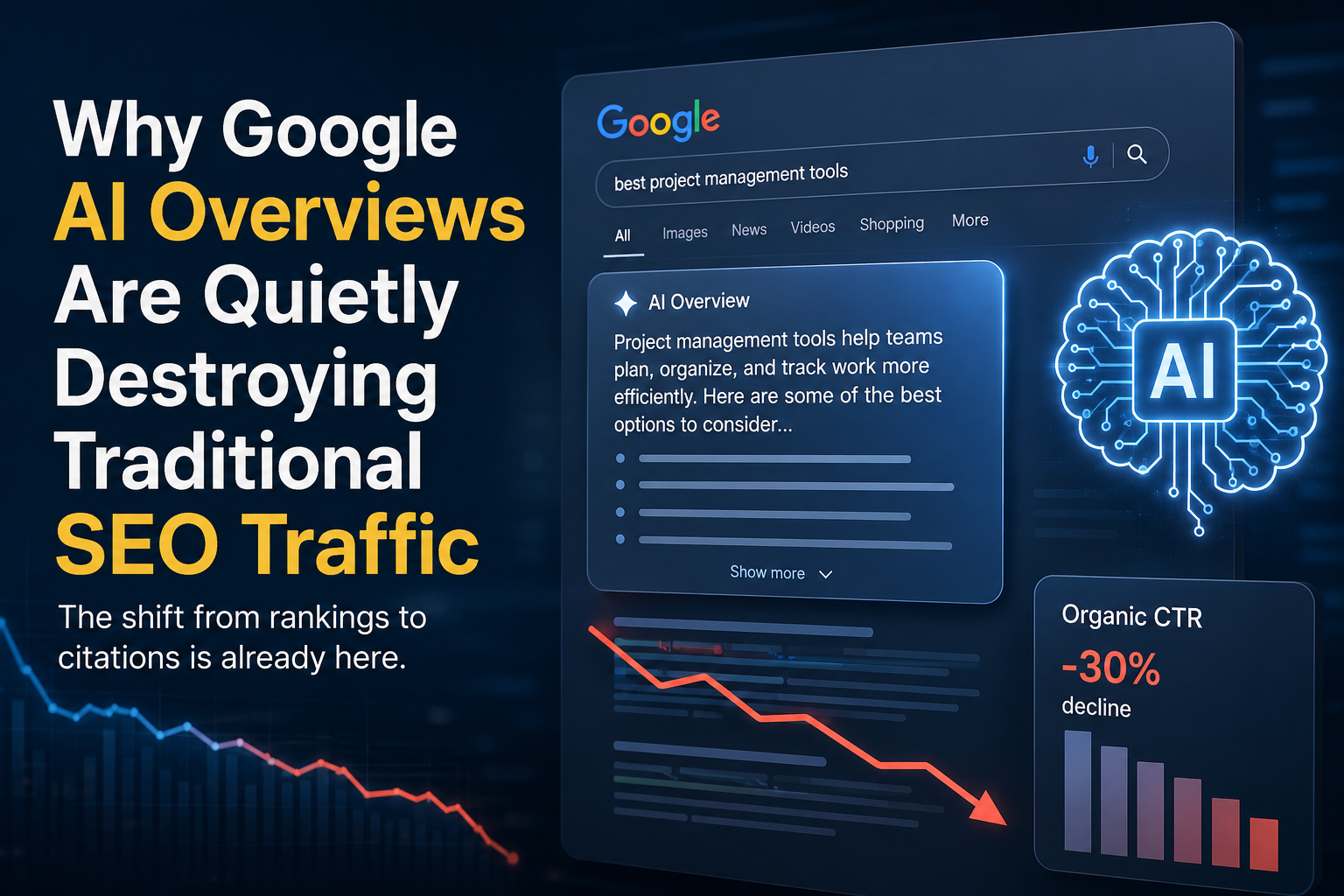
When Google surfaces an AI-generated summary at the top of a results page, covering the core question a user typed in, a meaningful percentage of those users simply don’t need to scroll further. They got their answer. The search is done.
This isn’t speculation. Search Engine Land reported on research showing that queries affected by AI Overviews have seen click-through rate drops that, in some cases, exceed 30%. That’s not a rounding error. For publishers and businesses that built their traffic model around informational content, that kind of CTR decline hits the economics directly.
Forbes has covered the wider implications, noting that publishers are increasingly alarmed by declining search traffic tied to AI-generated answers. The frustration is understandable. You’ve invested in content, you’re ranking, and yet the traffic isn’t arriving the way it used to.
The honest takeaway is that ranking and visibility are no longer the same thing. You can rank in position three and still see less organic traffic than you did two years ago at position five, because the user’s behaviour has changed above you.
This Isn’t Just About Google
It’s worth stepping back from Google for a moment, because AI Overviews are part of a larger shift in how people find information.
Platforms like ChatGPT, Perplexity AI, and Google’s own Search Generative Experience aren’t retrieving documents the way a traditional search engine does. They’re synthesising answers. They pull from multiple sources, weigh credibility signals, and produce a response, often without sending a user anywhere.
The implication for businesses is significant. Visibility in AI-driven environments isn’t primarily about ranking algorithms. It’s about whether your brand and your content are being treated as trustworthy source material.
That’s a fundamentally different problem to solve. And most SEO strategies aren’t built for it yet. Our AI SEO Services are specifically designed around this new reality, helping businesses build the kind of authority signals that AI systems actually respond to.
The Web Is Full of Content That Looks the Same
Here’s something that gets underappreciated in discussions about AI and SEO: generative AI hasn’t just changed how people search. It’s changed what the web looks like.
Go and search almost any SEO-adjacent topic right now. You’ll find dozens of articles with nearly identical structures, same introductory premise, same subheadings, same three-to-five examples, same closing paragraph about how “the landscape is evolving.” Technically accurate, often well-formatted, and completely interchangeable with each other.
This happened because AI writing tools made content production dramatically cheaper. Businesses that previously published two or three pieces a month are now publishing twenty. But volume doesn’t create authority. And in many cases, the things that made content genuinely useful, an original perspective, a real example, an author who has actually worked through the problem, got stripped out in the name of efficiency.
The result is an enormous amount of content that AI systems have to evaluate, where differentiation has become the scarcest resource.
Google’s own guidance on helpful content makes this point directly. The emphasis on people-first content, demonstrable expertise, and original insight isn’t just philosophical positioning. It reflects a real problem Google is trying to solve, which is that a huge chunk of the web now looks like it was produced by the same process.
If you’re wondering whether your current content strategy is heading in the right direction, our Content Writing Services focus specifically on depth and genuine value rather than just volume.
AI Overviews Don’t Always Cite the Top Results
This is the finding that should probably get more attention than it does.
Research published on arXiv examining Google AI Overview citations found that a substantial portion of the sources cited inside AI-generated answers were not the top-ranking organic results for the same query. In some cases, they weren’t ranking highly at all.
Read that again, because it changes the strategic picture considerably.
If AI systems are pulling from sources that aren’t necessarily the highest-ranking pages, then traditional SEO, which has always been primarily about moving up the rankings, may not be sufficient to earn visibility in AI-generated answers.
The concept being discussed in SEO circles is the difference between being ranked and being reference-worthy. A page can rank well and never appear in an AI Overview. A page with a more modest ranking position, but from a source that AI systems recognise as credible and authoritative, might get cited regularly.
That shifts the question from “how do we get this page to position one?” to “why would an AI system treat our site as a reliable source on this topic?”
Topical Depth Matters More Than Content Volume
One of the patterns that keeps coming up is businesses inadvertently weakening their own authority by publishing too broadly.
The logic behind it is understandable. More content means more keyword coverage, more chances to appear in search results, more surface area for traffic. And in traditional SEO, that logic held reasonably well.
But AI systems evaluate sources differently. When a website publishes hundreds of loosely connected articles across a wide range of topics, what that looks like from an AI’s perspective is a generalist source, not an authoritative one on any particular subject.
By contrast, a website that consistently covers a focused set of topics in genuine depth, returning to ideas from different angles, building on previous pieces, and demonstrating actual understanding rather than surface coverage, signals something quite different. It looks like a domain with real expertise.
Rand Fishkin has written extensively about this shift at SparkToro, specifically how zero-click search and AI-assisted discovery are changing what it means to build authority online. The argument isn’t that content volume is worthless. It’s that volume without depth actively dilutes the signals that matter.
External Authority Still Matters, But Quality Over Quantity
There’s a growing misconception in some corners of SEO that backlinks are becoming irrelevant as AI reshapes search. That’s an overcorrection.
External authority signals still carry significant weight. The question is what “quality” means in this context, and here the bar has genuinely raised.
A mention in a respected industry publication, a citation in a thoughtful editorial piece, or a reference in a widely-read newsletter carries substantially more weight than fifty links from low-traffic directories or thinly-constructed guest posts designed purely to pass link equity.
Brian Dean’s work on link building at Backlinko remains one of the more honest resources on this, particularly his emphasis on earning links through genuinely useful content and real relationships rather than link schemes.
What this means practically is that a single well-placed mention on an authoritative site in your industry does more for your visibility than a large volume of low-quality links. That’s true in traditional search, and it’s increasingly true in AI-driven search environments where credibility signals matter more than raw link counts. Our Link Building Services are built around exactly this principle: editorial placements and genuine outreach, not link farms.
What a More Honest SEO Strategy Looks Like
There isn’t a clean new playbook that replaces the old one. Anyone telling you there’s a simple system for “optimising for AI Overviews” is probably selling something.
What there is, though, is a clearer sense of what the businesses likely to perform well over the next few years have in common.
They’re publishing less, but better. Not chasing every keyword opportunity, but going genuinely deep on the areas where they have real expertise or real experience to draw on.
They’re thinking about their external presence as much as their website. Where do they get mentioned? Who references their work? What does their authority footprint look like across the web, not just on their own domain?
They’re writing for people, not just for search engines. This sounds obvious. It’s been Google’s stated guidance for years. But the number of sites still producing content that’s clearly shaped more by keyword density than genuine usefulness is striking.
And they’re patient. Building the kind of authority that makes AI systems treat you as a reliable source isn’t a six-week project. It’s a sustained effort across content quality, external relationships, and consistent expertise positioning.
If you’re not sure where your current strategy stands, our free SEO audit is a good starting point. We look at both traditional ranking factors and the newer authority signals that AI-driven search is beginning to weight more heavily.
The Bigger Picture
Search is becoming less about finding pages and more about synthesising answers. That’s a genuine structural shift, not a temporary algorithm update to wait out.
The businesses still treating SEO primarily as a content production exercise, more articles, more keywords, more pages, are building for a version of search that’s already beginning to fade. The economics of click-through traffic are changing, the signals AI systems weight are different from traditional ranking factors, and the web is already saturated with the kind of content that production-first strategies produce.
The ones most likely to maintain and grow their visibility are those investing in something harder to replicate: genuine expertise, consistent credibility, and a presence across the web that AI systems recognise as worth citing.